publications
publications by categories in reversed chronological order. generated by jekyll-scholar.
2026
- GRL
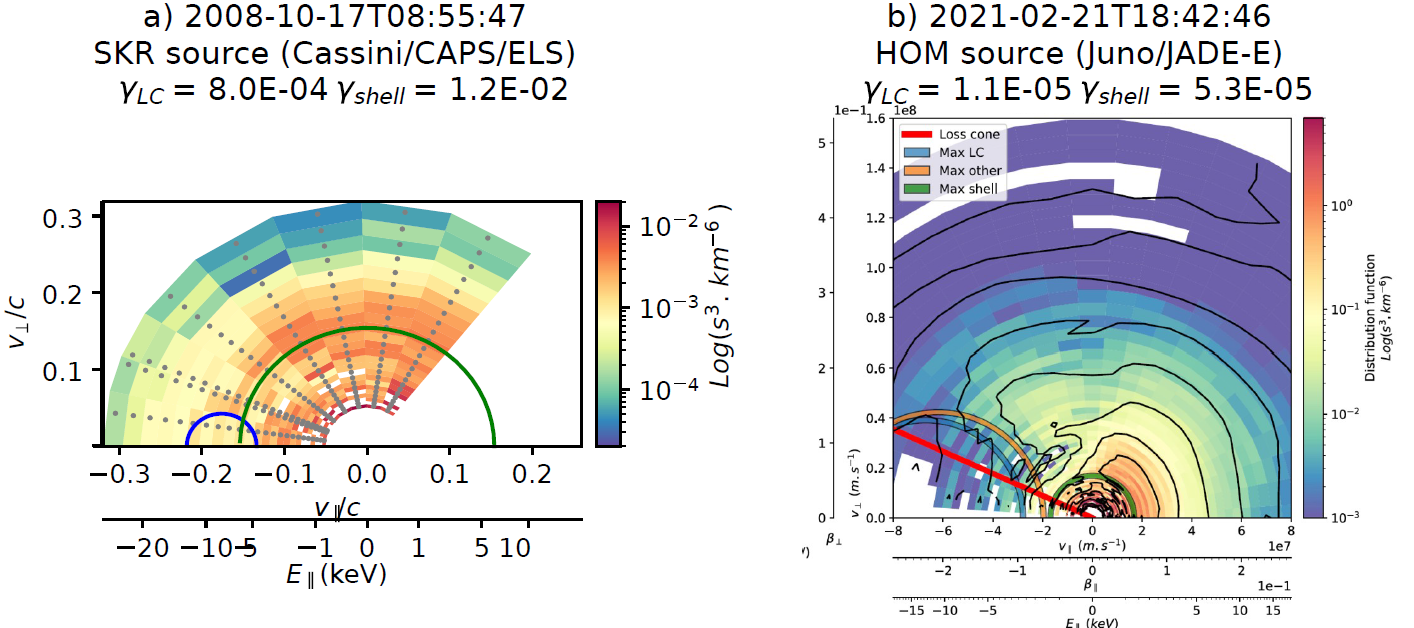 Reanalysis of SKR Source Crossed by Cassini: Loss Cone Electrons as a Secondary Source of Free EnergyB. Collet, L. Lamy, Y. Kasaba, and 1 more authorGeophysical Research Letters, Aug 2026
Saturn’s Kilometric Radiation (SKR) is a powerful non-thermal radio auroral emission produced by the Cyclotron Maser Instability (CMI), which generates waves close to the local cyclotron frequency in a highly magnetized plasma from mildly relativistic electrons. The source of free energy for SKR was identified by Cassini to be the monoenergetic shell (horseshoe) distributions of 6-12 keV. Since then, Juno identified loss cone and shell distributions as the main and secondary CMI sources of free energy at Jupiter. We reanalyze Cassini measurements during SKR source crossings. We identify similar empty loss cones between 1.6 and 8.9 keV on 6 occasions alongside shell distributions. We show that loss cone distributions are unstable by computing the CMI growth rate. The amplified waves are predicted to have frequencies between 1.003 fce and 1.017 fce with a beaming angle close to 80°. Finally, we compare our findings with those obtained at Jupiter.
- Sc. Ad.A radio oval above Earth’s auroral ovalSiyuan Wu, Daniel K. Whiter, Laurent Lamy, and 12 more authorsScience Advances, 2026
Auroral kilometric radiation (AKR), Earth’s strongest radio emission, has long been associated with discrete auroras and electrons near a few kilo–electron volt (keV) range. However, auroras also occur in diffuse forms with broader electron energies, raising the question of why AKR has not been observed above diffuse auroras or linked to electrons outside the kilo–electron volt population. Comprehensive AKR source distributions have remained elusive because of observational limitations, and their local-time coverage remains largely unknown. Using spacecraft measurements, we identify a “radio oval” above the optical auroral oval, spanning the full local-time range, where AKR is emitted over both discrete and diffuse auroras. The AKR source electrons display diverse precipitation features, including monoenergetic (peak flux at 3.82 kilo–electron volts), broadband (1.34 kilo–electron volts), low-energy (0.47 kilo–electron volts), and diffuse types (>1 kilo–electron volt). These results reveal that the cyclotron maser instability—the mechanism driving AKR—can arise in diverse plasma environments, broadening our understanding of both AKR generation and auroral complexity. Radio waves called AKR radiate above auroras, driven by diverse electron acceleration and precipitation processes.
- PRE X
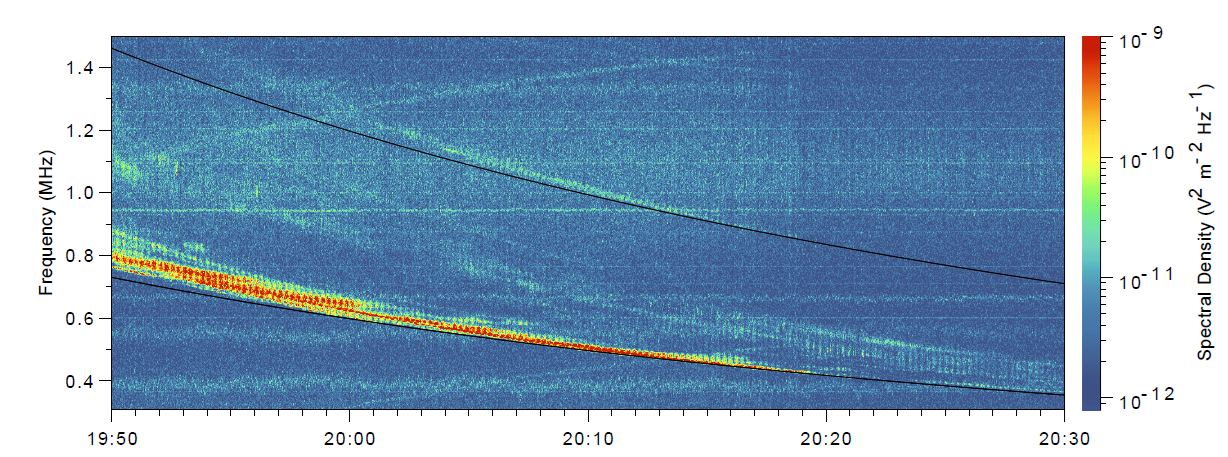 Detection of Jovian kilometric and hectometric auroral radio harmonics with Juno/Waves in situ measurementsB. Collet, L. Lamy, W. S. Kurth, and 3 more authorsIn Planetary, Solar and Heliospheric Radio Emissions X, 2026Accepted, preprint
Auroral radio emissions from Earth, Saturn, and Jupiter are now known to all be generated by the cyclotron maser instability near the electron cyclotron fundamental frequency f_ce. This common generation mechanism results in similar wave properties in terms of beaming and polarization. However, while harmonics at 2 f_ce and 3 f_ce have been identified in the terrestrial and kronian cases, none of the components of Jupiter’s auroral radio spectrum had been associated with harmonics. In this study, we confirm the existence of first harmonic emissions for the Jovian broadband-kilometric (bKOM) and hectometric (HOM) components (200-700 kHz) in 6 cases using in situ data from Juno/Waves observations close to the source. Among these cases, 2 second harmonics were also identified. These harmonics are three orders of magnitude weaker than the associated fundamental and were identified in regions where the f_pe/f_ce(f_pe the electron plasma frequency) ratio is of the order of 10^-2. This discovery confirms the universality of the CMI and suggests that harmonics in the decametric range could exist.
- Search for the influence of the Galilean moons on Jovian kilometric and decametric radio emissions over 7 years of Juno dataC. K. Louis, A. Boudouma, R. Prangé, and 6 more authorsIn Planetary, Solar and Heliospheric Radio Emissions X, 2026
The radio emissions generated at Jupiter by the Cyclotron Maser Instability (CMI) are categorized based on their frequency –kilometric, hectometric, or decametric; hectometric and decametric components are relatively continuous, see, e.g., Zarka et al. (2021)– and their origin, whether auroral or induced by the Galilean moons. Regarding the latter category, the moons Io, Europa, and Ganymede are known to influence Jupiter’s decametric radio spectrum. Emissions induced by Io have long been observed from Earth in the decametric range and were later confirmed down to the hectometric range by space missions. By contrast, radio signatures from Europa and Ganymede in the hectometric and decametric ranges have only been confirmed recently, through both ground–based and spacecraft observations. However, no clear evidence has yet been found of their influence in the kilometric range. In this study, we present an extended search for radio emissions induced by Europa, Ganymede, and Callisto, using seven years of Juno spacecraft observations. Io’s influence on the decametric radio emission is presented for the first time across the full [3.5–40] MHz range and from all latitudes. In the kilometric range, potential influence by the four different Galilean moons is observed for Io (in both hemispheres), Europa (Southern hemisphere), Ganymede (both hemispheres) and Callisto (both hemispheres).
2025
- GRL
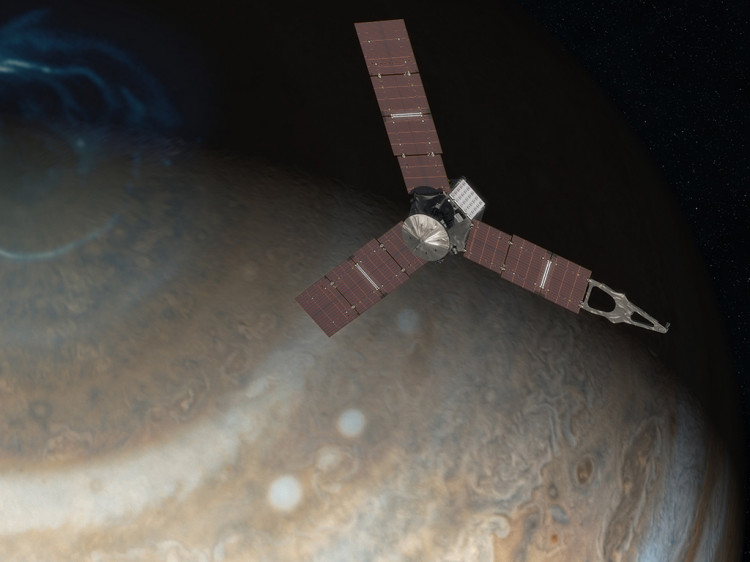 In Situ Analysis of Jupiter’s Broadband Kilometric Auroral Radio Emissions With JunoB. Collet, L. Lamy, C. K. Louis, and 2 more authorsGeophysical Research Letters, 2025
Among the zoo of Jovian auroral radio emissions, the broadband kilometric (bKOM) component has been the least studied. Taking advantage of Juno in situ measurements within the auroral regions, we surveyed the Juno/Waves radio observations over the 60 first orbits to identify 7 bKOM source candidates. These were mostly detected during dawn storm auroral episodes (4/7) and three were found to be colocated with auroral cavities. By applying a growth rate analysis based on JADE-E electron measurements, we show that the observed waves are driven by the Cyclotron Maser Instability from two free energy sources. The main emission, produced slightly above the electron gyrofrequency fce, is amplified by conics-type electron distribution functions (EDF) with 2─30 keV electron characteristic energies. Sporadic bursts, produced slightly below fce, are driven by shell-type EDF of 0.1─10 keV. These results are analyzed comparatively to those obtained previously for Jovian hectometric and decametric emissions
- Nat ComIn situ and remote observations of the ultraviolet footprint of the moon Callisto by the Juno spacecraftJ. Rabia, V. Hue, C. K. Louis, and 23 more authors2025
Jupiter exhibits peculiar multiwavelength auroral emissions resulting from the electromagnetic interactions of Io, Europa, and Ganymede with the magnetospheric plasma flow. Characterizing the faint auroral footprint of the fourth Galilean moon, Callisto, has always been challenging because of its expected weakness and its proximity to Jupiter’s bright main aurora. Here, we report on unusual magnetospheric conditions that led to an equatorward shift of Jupiter’s main auroral oval unveiling the auroral footprints of the four Galilean moons in a single observation. Remote observations by the Juno spacecraft reveal a double-spot structure, characteristic of the footprints of the other three moons, with a maximum ultraviolet brightness of 137±15 kR. Concurrent observations within Callisto’s flux tube reveal field-aligned electrons with a characteristic energy of 10 keV, depositing an energy flux of 55 mW.m-2 in Jupiter’s atmosphere. The electron properties are consistent with the triggering of radio emissions with intensities lower than 5 × 10-18 W.m-2.Hz-1.
- EDPPrecipitating electron properties of Ganymede’s aurora retrieved from Juno/UVS observations during PJ34B. Benmahi, V. Hue, A. Vorburger, and 18 more authorsAstronomy &; Astrophysics, 2025
Context. Ganymede’s UV aurorae, observed by HST and Juno/UVS, trace interactions between its atmosphere and Jupiter’s magneto-sphere. These emissions, dominated by O I lines at 130.4 and 135.6 nm, are driven by electron impact on species such as H2O, O, and O2, and yet the properties of the precipitating electrons remain poorly constrained. Aims. Our aim was to retrieve the energy and flux of precipitating electrons using UV observations from Juno/UVS during PJ34 and to assess the dominant atmospheric species producing the observed emissions. Methods. Using the TransPlanet electron transport model and a non-local thermodynamic equilibrium (non-LTE) radiative transfer module, we simulated O I emissions for 17 auroral subregions, testing both monoenergetic and kappa-type electron distributions. The I(135.6 nm)/I(130.4 nm) line ratio was used as a diagnostic, with values varying by target species. Results. Monoenergetic distributions fit most regions better, with mean energies of 17─300 eV and fluxes up to 2 mW m−2. Kappa and Maxwellian distributions yielded higher fluxes, but poorer spectral fits. Poor fits in some regions reflect low S/N or non-ideal electron populations. Conclusions. Our results suggest that Ganymede’s UV aurorae are mainly driven by low- to intermediate-energy electrons. Upcoming high-resolution observations and in situ data from Juice and Europa Clipper will be key to refining these diagnostics.
-
 Comprendre la microphysique des émissions radio aurorales de Jupiter avec JunoUnderstanding the microphysics of Jovian auroral radio emissions with JunoB. Collet2025Thèse de doctorat dirigée par Lamy, L. au Laboratoire d’Astrophysique de Marseille, Aix-Marseille Université
Jupiter is the most intense source of auroral radio emissions in the Solar System. These emissions are emitted perpendicular to the magnetic field in a hollow cone at a frequency close to the cyclotron frequency. These emissions have since been observed and characterized by ground- and space-based observations and are now divided into four categories: the decametric emissions (DAM), including those induced by the Galilean moons (Moon-DAM), the hectometric emissions (HOM), and the broadband kilometer emissions (bKOM). They are produced in the polar regions of Jupiter’s magnetosphere, a unique laboratory due to its size and internal processes. These emissions are generated by a wave-plasma instability: the Cyclotron Maser Instability (CMI). It requires a depleted and magnetized plasma and an electronic population inversion. The aim of this thesis is to confirm CMI as the generation mechanism for Jovian auroral radio emissions. To do this, I use in situ radio, plasma, and magnetic measurements from Juno, the first polar orbiter to cross Jupiter’s auroral regions. From radio spectra, I have compiled a catalog of candidate radio source crossings, which were then confirmed by a growth rate analysis based on Juno’s electron measurements and a new expression of the growth rate. I found that HOM and DAM sources were generated mainly by EDF with a loss cone, and marginally by conics, and shells which I identified for the first time at Jupiter. The bKOM sources were produced by conics and shells, and could be located in cavities. These results confirm the universality of CMI for the generation of auroral radio emissions and could be applied to other magnetized planets.
2024
- JGR
 A New Type of Jovian Hectometric Radiation Powered by Monoenergetic Electron BeamsB. Collet, L. Lamy, C. K. Louis, and 5 more authorsJournal of Geophysical Research: Space Physics, 2024
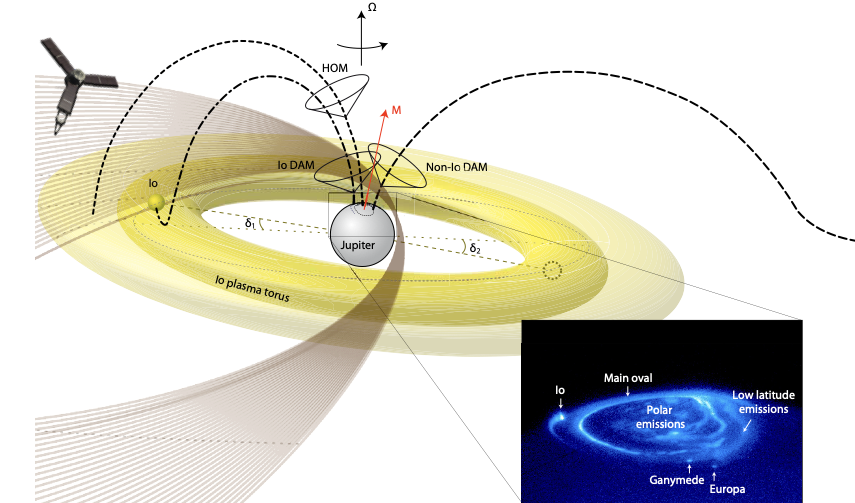
In this study, we statistically analyze the Jovian auroral radio sources detected in situ by Juno/Waves at frequencies f below the electron cyclotron frequency fce. We first conduct a survey of Juno/Waves data over 1-40 MHz from 2016 to 2022. The 15 detected HectOMetric (HOM) sources all lie within 1-5 MHz and are both less frequent than the radio sources commonly observed slightly above fce and clustered in the southern hemisphere, within ∼90-270° longitudes. We analyze these emission regions with a growth rate analysis in the framework of the Cyclotron Maser Instability (CMI), which we apply to JADE-E high cadence electron measurements. We show that the f < fce emissions correspond to crossed radio sources, ∼300 km wide. They are located in a hot and highly depleted auroral plasma environment, along flux tubes colocated with upward field-aligned current and at the equatorward edge of the main auroral oval. The wave amplification is consistent with the CMI and its free energy source consists of a shell-type electron distribution function (EDF) with characteristic energies of 0.2-5keV. More energetic, 5-50 keV, shell-type EDFs were systematically observed at higher latitudes but without any radio counterpart. Various parameters for the f < fce HOM sources, reminiscent of the ones at Earth/Saturn, are compared. Other CMI-unstable EDFs, primarily loss cone ones, are systematically observed during the same intervals, giving rise to emission observed at fce < f < fce + 0.5%. Our analysis thus reveals that different portions of the same EDF can be CMI-unstable and simultaneously amplify radio waves below and above fce.
- A & AThe SOPHIE search for northern extrasolar planets: XIX. A system including a cold sub-Neptune potentially transiting a V = 6.5 star HD 88986N. Heidari, I. Boisse, N. C. Hara, and 51 more authorsAstronomy &; Astrophysics, 2024
Transiting planets with orbital periods longer than 40 d are extremely rare among the 5000+ planets discovered so far. The lack of discoveries of this population poses a challenge to research into planetary demographics, formation, and evolution. Here, we present the detection and characterization of HD 88986 b, a potentially transiting sub-Neptune, possessing the longest orbital period among known transiting small planets (<4 R⊕) with a precise mass measurement (σM/M > 25%). Additionally, we identified the presence of a massive companion in a wider orbit around HD 88986. To validate this discovery, we used a combination of more than 25 yr of extensive radial velocity (RV) measurements (441 SOPHIE data points, 31 ELODIE data points, and 34 HIRES data points), Gaia DR3 data, 21 yr of photometric observations with the automatic photoelectric telescope (APT), two sectors of TESS data, and a 7-day observation of CHEOPS. Our analysis reveals that HD 88986 b, based on two potential single transits on sector 21 and sector 48 which are both consistent with the predicted transit time from the RV model, is potentially transiting. The joint analysis of RV and photometric data show that HD 88986 b has a radius of 2.49 ± 0.18 R⊕, a mass of 17.2‑3.8+4.0 M⊕, and it orbits every 146.05‑0.40+0.43 d around a subgiant HD 88986 which is one of the closest and brightest exoplanet host stars (G2Vtype, R = 1.543 ± 0.065 R⊙, V = 6.47 ± 0.01 mag, distance = 33.37 ± 0.04 pc). The nature of the outer, massive companion is still to be confirmed; a joint analysis of RVs, HIPPARCOS, and Gaia astrometric data shows that with a 3σ confidence interval, its semi-major axis is between 16.7 and 38.8 au and its mass is between 68 and 284 MJup. HD 88986 b’s wide orbit suggests the planet did not undergo significant mass loss due to extreme-ultraviolet radiation from its host star. Therefore, it probably maintained its primordial composition, allowing us to probe its formation scenario. Furthermore, the cold nature of HD 88986 b (460 ± 8 K), thanks to its long orbital period, will open up exciting opportunities for future studies of cold atmosphere composition characterization. Moreover, the existence of a massive companion alongside HD 88986 b makes this system an interesting case study for understanding planetary formation and evolution.
2023
- JGRSource of Radio Emissions Induced by the Galilean Moons Io, Europa and Ganymede: In Situ Measurements by JunoC. K. Louis, P. Louarn, B. Collet, and 13 more authorsJournal of Geophysical Research: Space Physics, 2023
At Jupiter, part of the auroral radio emissions are induced by the Galilean moons Io, Europa and Ganymede. Until now, except for Ganymede, they have been only remotely detected, using ground–based radio–telescopes or electric antennas aboard spacecraft. The polar trajectory of the Juno orbiter allows the spacecraft to cross the range of magnetic flux tubes which sustain the various Jupiter–satellite interactions, and in turn to sample in situ the associated radio emission regions. In this study, we focus on the detection and the characterization of radio sources associated with Io, Europa and Ganymede. Using electric wave measurements or radio observations (Juno/Waves), in situ electron measurements (Juno/JADE–E), and magnetic field measurements (Juno/MAG) we demonstrate that the Cyclotron Maser Instability (CMI) driven by a loss–cone electron distribution function is responsible for the encountered radio sources. We confirmed that radio emissions are associated with Main (MAW) or Reflected Alfvén Wing (RAW), but also show that for Europa and Ganymede, induced radio emissions are associated with Transhemispheric Electron Beam (TEB). For each traversed radio source, we determine the latitudinal extension, the CMI–resonant electron energy, and the bandwidth of the emission. We show that the presence of Alfvén perturbations and downward field–aligned currents are necessary for the radio emissions to be amplified.
- PRE IXCharacterization of Jovian hectometric sources with Juno: statistical position and generation by shell-type electronsB. Collet, L. Lamy, C. K. Louis, and 5 more authorsIn PRE IX, 2023
The Juno orbiter has been exploring the polar magnetosphere of Jupiter since mid-2016. Thanks to its unique polar trajectory, it has crossed regularly the north- ern and southern sources of auroral hectometric radiation, acquiring pioneer radio, magnetic and electron in situ measurements. By conducting a survey of the first 10 perijoves, we show evidence of a systematic spatial conjugacy between the crossed hectometric sources and the zone of diffuse aurora. In the framework of the elec- tron Cyclotron Maser Instability (CMI), we used electron distribution functions measured by JADE-E to derive (i) the CMI expected growth rate, (ii) the asso- ciated electron energy and (iii) the emission frequency. We then compared these values to the wave properties measured by Waves. In addition to the two CMI sources of free energy already identified in the literature (loss cone and conics), we show that shell-type electrons of about 1—5 keV are driving emission below the electron cyclotron frequency (as at Earth and Saturn).
- PRE IXRe-exploring the radio spectrum of Uranus in orbit: science case and digital high-frequency receiverL. Lamy, B. Cecconi, M. Dekkali, and 12 more authorsIn PRE IX, 2023
Among the known planetary magnetospheres, those of Uranus and Neptune display very similar radio environments so that they were referred to as radio twins. Their pioneering exploration by the Voyager 2 Planetary Radio Astronomy (PRA) and Plasma Wave Science (PWS) experiments revealed a variety of electromagnetic radio waves ranging from a few kHz to a few tens of MHz similar to -although more complex than- those of Saturn or the Earth. The asymmetric magnetosphere of Uranus is highly atypical with a large obliquity, magnetic tilt and fast rotation period, so that the magnetosphere undergoes perpetual geometric recon guration. Hereafter, we review the rich zoo of Uranian radio emissions, including the auroral Uranian Kilometric Radiation (UKR) between a few kHz and 1 MHz, the Uranian Electrostatic Discharges (UED) observed up to 40 MHz, and low frequency waves (continuum, plasma wave emissions) at a few kHz. We then emphasize the interest of re-exploring this atypical radio source and present a modern concept of a digital High Frequency Receiver (HFR) in the framework of a Radio and Plasma Wave (RPW) experiment to be proposed to any future NASA/ESA orbital mission toward Uranus. This HFR concept, updated from the heritage of Cassini/RPWS/HFR, STEREO/Waves, Bepi-Colombo/PWI/Sorbet or Solar Orbiter/RPW is aimed at providing a light, robust, low-consumption versatile instrument capable of goniopolarimetric (polarization and direction-finding capabilities) and waveform measurements from a few kHz to 40MHz, devoted to the study of radio emissions, plasma waves and dust impacts.
2022
- JGRMagnetosphere -Ionosphere -Thermosphere Coupling Study at Jupiter Based on Juno’s First 30 Orbits and Modeling ToolsS. Al Saati, N. Clément, C. Louis, and 15 more authorsJournal of Geophysical Research: Space Physics, 2022
The dynamics of the Jovian magnetosphere is controlled by the interplay of the planet’s fast rotation, its solar-wind interaction and its main plasma source at the Io torus, mediated by coupling processes involving its magnetosphere, ionosphere, and thermosphere. At the ionospheric level, these processes can be characterized by a set of parameters including conductances, field-aligned currents, horizontal currents, electric fields, transport of charged particles along field lines including the fluxes of electrons precipitating into the upper atmosphere which trigger auroral emissions, and the particle and Joule heating power dissipation rates into the upper atmosphere. Determination of these key parameters makes it possible to estimate the net transfer of momentum and energy between Jovian upper atmosphere and equatorial magnetosphere. A method based on a combined use of Juno multi-instrument data and three modeling tools was developed by Wang et al. (2021, https://doi.org/10.1029/2021ja029469) and applied to an analysis of the first nine orbits to retrieve these parameters along Juno’s magnetic footprint. We extend this method to the first 30 Juno science orbits and to both hemispheres. Our results reveal a large variability of these parameters from orbit to orbit and between the two hemispheres. They also show dominant trends. Southern current systems are consistent with the generation of a region of sub-corotating ionospheric plasma flows, while both super-corotating and sub-corotating plasma flows are found in the north. These results are discussed in light of the previous space and ground-based observations and currently available models of plasma convection and current systems, and their implications are assessed.